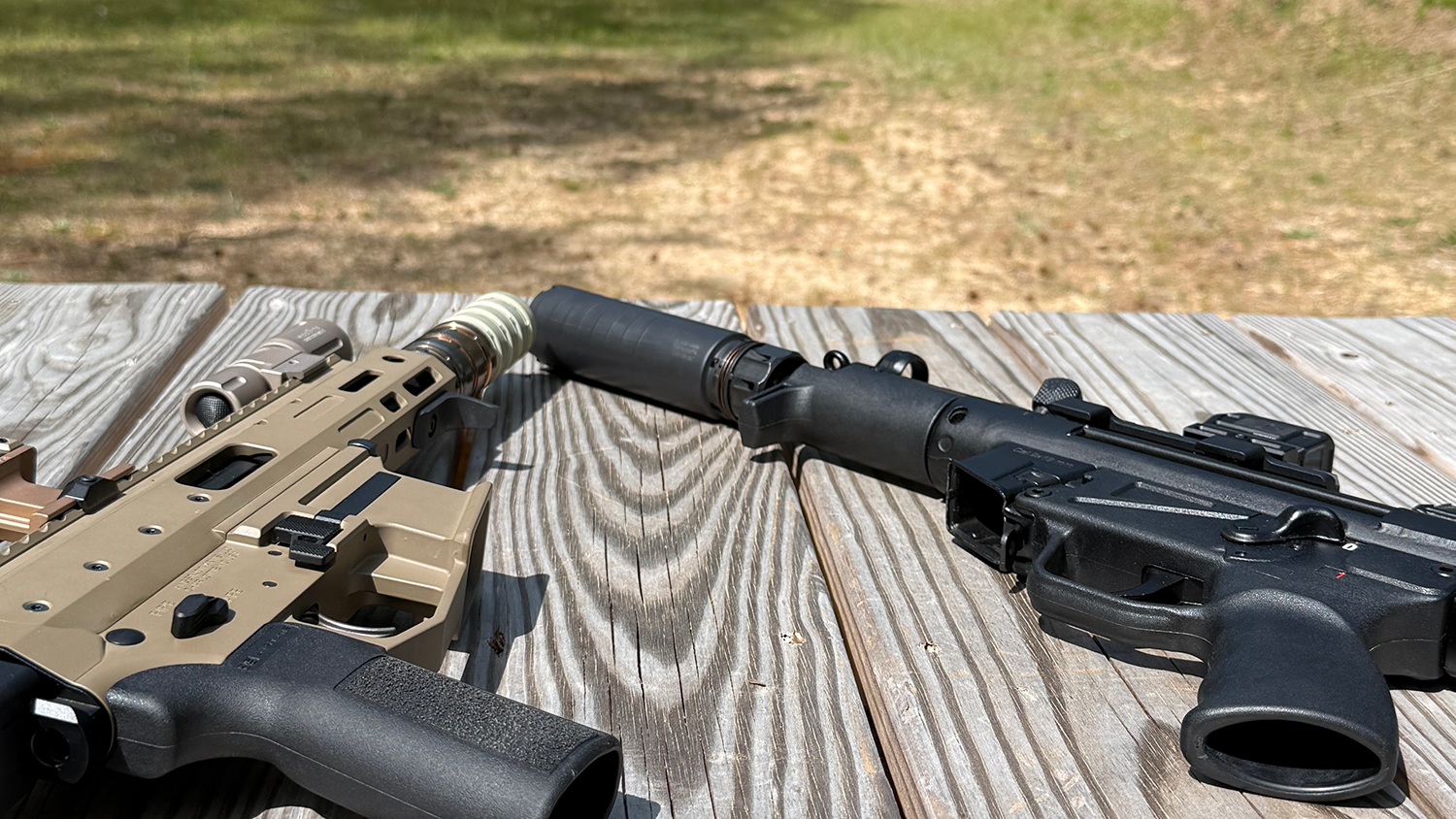
NFA / Class III Purchases
Suppressors, short-barrelled rifles, short-barrelled shotguns and other National Firearms Act items are lawful to own in most states, but they are bought differently to a standard firearm. There is a federal registration, a tax stamp, fingerprints, photographs and a wait. None of it is difficult once you understand the sequence, and this page walks through the whole thing.
What counts as an NFA item
| Category | What it means | Transfer tax |
|---|---|---|
| Suppressor | A device that reduces the report of a firearm, often called a silencer in the statute | $200 |
| Short-barrelled rifle | A rifle with a barrel under 16 inches or an overall length under 26 inches | $200 |
| Short-barrelled shotgun | A shotgun with a barrel under 18 inches or an overall length under 26 inches | $200 |
| Any other weapon | A catch-all category including certain pistol-grip firearms and disguised firearms | $5 |
| Machine gun | Transferable examples only, manufactured before May 1986 | $200 |
| Destructive device | Certain large-bore firearms and explosive ordnance | $200 |
The process, step by step
- Choose your item and your dealerNFA items must be transferred through a dealer holding a Special Occupational Tax classification, usually called an SOT or a Class III dealer. Not every FFL holds one, so confirm before you order.
- Buy from usYou pay for the item here. We ship it to your SOT dealer once their licence and SOT status are verified, exactly as with any firearm transfer.
- Decide how you will register itYou can register as an individual, through a gun trust, or through a corporation. Individuals are simplest. A trust allows more than one person to possess the item lawfully and can simplify inheritance, but every responsible person on the trust must submit their own fingerprints and photographs.
- File ATF Form 4Your dealer prepares the transfer application. You provide passport-style photographs and two fingerprint cards, and a copy goes to your chief local law enforcement officer as notification.
- Pay the tax$200 for most categories, $5 for an any other weapon. This is a one-time federal transfer tax, paid per item, not an annual charge.
- Wait for approvalElectronic filings have shortened waits considerably, but the timeline still moves with ATF workload. Your dealer holds the item, in their book, throughout.
- Collect your stamp and your itemOnce the approved form comes back with the stamp, you collect from your dealer. Keep a copy of the stamp with the item whenever you transport it.
Individual, trust or corporation
Individual
Simplest and cheapest. Only you may possess the item. On your death it passes to an heir on a tax-free Form 5 transfer, but nobody else may use it while you are alive without you being present.
Gun trust
Allows named trustees to possess and use the item independently, and makes succession planning cleaner. Costs more to set up and every responsible person files fingerprints and photographs. Have it drafted by an attorney familiar with NFA law rather than a template.
Corporation or LLC
Occasionally used by businesses and dealers. Rarely the right answer for an individual collector because of the ongoing filing obligations.
Suppressors: what actually matters
Buyers focus on decibel figures, which are measured under conditions you will never replicate at your range. Weight, length, mounting system and durability rating matter more day to day. A titanium can that saves eight ounces changes how a rifle handles far more than two decibels on a spec sheet. Check the mount, the bore diameter, the rated calibres, whether full-auto is permitted and whether the manufacturer allows short-barrel use, because running a can outside its rating is how baffles get struck.
You will also need a host that is set up for it: a threaded barrel with the correct pitch, a suitable muzzle device if the can uses one, and sights or an optic that still work with the added length.
Owning and travelling with NFA items
- Keep a copy of the approved stamp with the item, and the original somewhere safe at home.
- Interstate travel with a short-barrelled rifle, short-barrelled shotgun, machine gun or destructive device requires prior approval on ATF Form 5320.20. Suppressors do not require this, though the destination state must allow them.
- Only a lawful possessor may have control of the item. With an individual registration, that means you.
- Notify the ATF of a change of address for the categories that require it, and report loss or theft immediately.
Common misunderstandings
Is the $200 an annual fee?
No. It is a one-time transfer tax per item. If you later sell the item, the new buyer pays their own transfer tax.
Do I need special permission every time I use it?
No. Once approved and in your possession, you use it like any other firearm within the law of the state you are in.
Can my spouse use my suppressor?
If it is registered to you as an individual, only you may possess it. A trust with your spouse as a trustee is the usual solution.
Can I cancel while waiting for approval?
Once a Form 4 is filed, the item is committed to the transfer. Cancellation is possible in limited circumstances but the tax is generally not refundable. Be certain before you file.
Do I have to tell the police?
A copy of the application is sent to your chief local law enforcement officer as a notification. Their permission is not required.
Thinking about your first stamp?
Tell us your state, your host rifle and what you want the item to do, and we will point you at the right hardware and a dealer who can process it.
Talk to us about NFAShop NFA & Class IIIGeneral information only, not legal advice. NFA rules and processing times change. Always confirm current requirements with the ATF, your SOT dealer or an attorney experienced in firearms law.
Quick Answers About NFA Items
Most buyers researching NFA items want the same three answers: is it legal where I live, how long does the tax stamp take, and what happens if I move states with a suppressor or short-barreled rifle. NFA items are transferred through a licensed SOT dealer, not shipped directly to your door, and every application is reviewed by the ATF before you take possession. For the official rules on NFA items, registration, and current tax stamp processing times, see the ATF National Firearms Act page.
NFA Items We Regularly Help Customers Purchase
NFA items cover a specific category of products regulated separately from standard firearms, including suppressors, short-barreled rifles, and short-barreled shotguns. Buying NFA items always involves the tax stamp process, which is the part of the transaction that takes the longest and cannot be rushed regardless of the dealer.
How long does the NFA items tax stamp take?
Approval times for NFA items vary depending on which method you file under, and the wait has historically ranged from a few weeks to several months. We will keep you updated on where your NFA items stand in the process, but the final timeline is set by the ATF, not by us.
Can I use a trust to purchase NFA items?
Yes. Many customers buy NFA items through a gun trust rather than as an individual, which can simplify passing NFA items to family members later without a separate transfer. Setting up a trust is a legal step outside what we handle directly, so we recommend speaking with an attorney familiar with NFA items in your state before you file.